Helium may seem harmless—it’s the gas that makes balloons float and voices squeak—but in enclosed spaces, a helium leak can be dangerous. Because helium is colorless, odorless, and chemically inert, it is extremely difficult to detect. Worse, if too much helium builds up indoors, it can push out oxygen, creating a serious risk of suffocation.
Traditional gas sensors struggle with helium because they rely on chemical reactions, and helium simply doesn’t react. Now, researchers at Nanjing University have developed a clever new way to detect helium leaks—by listening for them.
In a study published in *Applied Physics Letters*, the team introduced a sound-based sensor that can identify helium leaks quickly and accurately by tracking changes in sound waves. Instead of relying on chemistry, the device uses physics—specifically, how sound behaves in different gases.
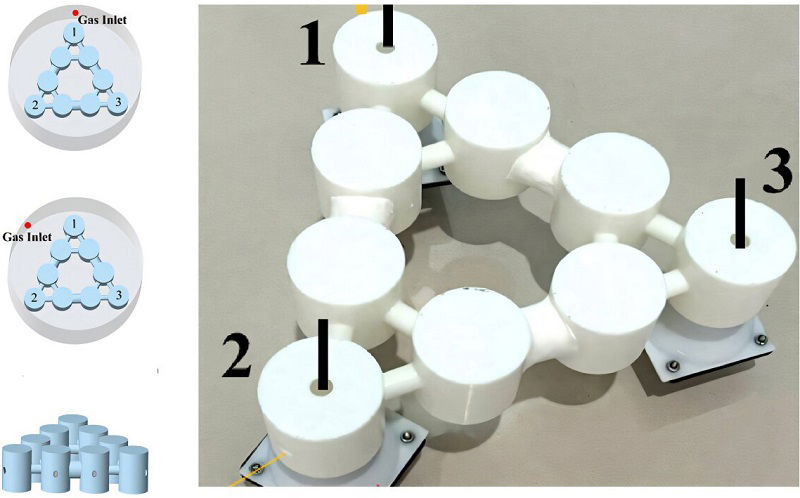
The design of the sensor is inspired by a traditional Japanese bamboo weaving technique called Kagome-biki. This weaving style creates a repeating triangular pattern, and the researchers translated that idea into a small physical structure made up of nine hollow cylinders arranged in interconnected triangles. Tiny tubes connect the cylinders so air—or any leaking gas—can flow freely throughout the device.
Speakers placed beneath the structure send sound waves upward into the cylinders, while microphones at the corners listen carefully. Under normal conditions, the sound waves bounce around inside the structure at very specific frequencies.
Every object has a natural resonant frequency—a kind of “favorite” vibration speed—and when sound matches that frequency, the vibrations become much stronger and easier to detect.
The key insight behind the device is that sound travels at different speeds in different gases. In helium, sound moves much faster than it does in air. When helium enters the sensor, it changes the density of the gas inside. That sudden change alters how fast the sound waves move, which in turn shifts the resonant frequency of the system.
As a result, the microphones detect a sharp change in the loudness and frequency of the sound. By measuring this shift, the researchers can tell not only that helium is present, but also estimate how much helium is in the surrounding air.
The sensor has several important advantages. Because it relies on sound rather than chemical reactions, its sensitivity stays stable even when temperature or humidity changes. This makes it especially useful in extreme environments, such as very cold industrial settings where traditional gas sensors often fail.
The triangular design also adds another benefit: it helps pinpoint where a leak is coming from. By observing which corner of the device detects the sound shift first, the researchers can determine the direction of the helium leak across a flat, two-dimensional area.
Looking ahead, the team hopes to expand the system so it can locate leaks in three dimensions and be miniaturized into a portable, easy-to-use detector. If successful, this sound-based approach could offer a safer and more reliable way to monitor helium in laboratories, hospitals, industrial plants, and other sensitive environments.
By combining ancient design principles with modern physics, the researchers have shown that sometimes the best way to solve an invisible problem is simply to listen carefully.
https://knowridge.com/2025/12/how-a-bamboo-inspired-design-helps-detect-dangerous-helium-escapes/