Getting Your Trinity Audio Player Ready: “The Da Vinci Code” as a Play?
Those familiar with Dan Brown’s novel recall a detective thriller that features an extremely complex debate about two millennia of theological history. That amount of exposition, on a stage, can be pure kryptonite. Given this intriguing challenge, director Jennifer Copaken and Palo Alto Players do their damnedest, and in the end it’s much like Orville and Wilbur’s flight—it’s hell getting that thing up in the air, but once you’re up, it’s quite a view.
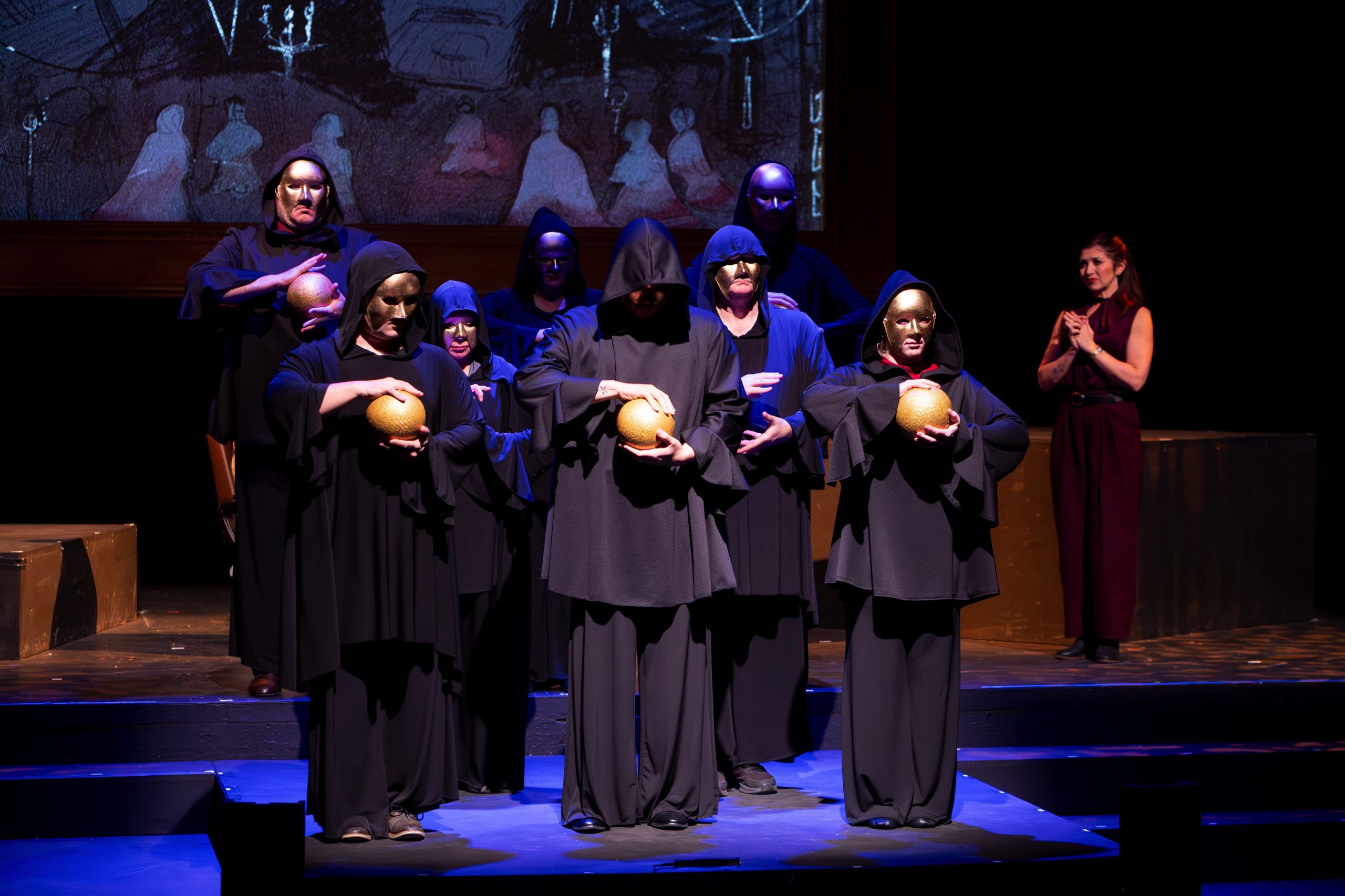
A large part of the production’s innovative approach comes in the form of motion: two dancers and several cloaked figures swirl about with geometric blocks, assembling them into formations that give clues about the coming scene. One of the most notorious images is that of Louvre curator Jacques Saunière (Stephen Sammonds), freshly murdered and lying naked on the museum’s floor in a peculiar posture. (No worries— all the crucial “parts” are covered.)
Detectives Bezu Fache and Collette (Dane Lentz and Setareh Greenwood) arrive on the scene with Robert Langdon (Christian Vaughn-Munck), an American professor they commandeered from a TED talk on symbology, to interpret this very strange tableau. Apparently, the dying Saunière arranged himself that way in an effort to deliver a deeply encoded message to his granddaughter, police cryptographer Sophie Neveu (Alli Gamlen).
After discovering a number of anagrams and mathematical clues written on the glass over the Mona Lisa in the victim’s blood, Langdon is hustled off by Neveu, who seems certain that no one—including the detectives—is trustworthy. Thus, we have our odd couple, and they couldn’t be better cast.
Gamlen is a fast-talking spitfire who wends her way through the labyrinthine clues while delivering some fine moments of martial artistry. Apparently, in the Paris Police, even cryptographers kick butt. Vaughn-Munck plays Langdon with just the right bookworm awkwardness, and it’s great fun to watch him light up when he solves the various anagrams, formulas, and paintings. He also provides much-needed moments of humor, such as when he delivers a sincere apology to the bad guys he and Sophie have just tied up.
(I hate to draw comparisons, but the similarity of both actors to Audrey Tautou and Tom Hanks from the 2006 film adaptation is hard to miss.)
Fortunately, the lengthy discussions of Christian lineage and secret theological forces are broken up by stimulating fight scenes. Director Copaken, who also works as a choreographer, does not pull her punches. In one scene, the very petite Gamlen jumps on a larger opponent’s back and drives him into the ground. I hope she’s getting hazard pay.
David Boyll contributes some eccentric fun as British Grail scholar Sir Leigh Teabing. He’s accompanied by his oddly surly servant Rémy (George Alexander K.). Brandon Dean invests the homicidal monk Silas with palpable intensity. (Their costumes, on the other hand, could be more flattering.)
The projections by Tasi Alabastro are both helpful and entertaining, as numbers, artworks, and anagrams fly about the stage.
The play is a good reminder of how provocative the mega-selling novel was. More orthodox patrons might find the various theories a bit upsetting. But keep this in mind: Dan Brown himself has said that he was operating from a buffet of scholarly theories, picking and choosing which ones might fit his narrative, and that the conclusions in the book were not meant to be understood as fact.
What does stand out, however, is that the various councils that determined which gospels would be included in or omitted from the New Testament, along with the writings of St. Paul and the dogma of the Roman Catholic Church, succeeded in virtually erasing the importance of female figures in the Jesus story. I’m not the only critic to conclude that this, more than anything, was what all those “Da Vinci Code” readers were responding to—the hunger of women to be better represented in their own churches.
In this way, Brown’s book is one of those rare novels (Uncle Tom’s Cabin, The Jungle, Grapes of Wrath) that actually moved the dial on a major social issue.
The big payoff, then, of all the duress this adaptation places on its performers (including several different accents) is an intellectual buzz that will stay with the viewer for days and weeks after the curtain drops.
“The Da Vinci Code” runs through Feb. 1 at the Lucie Stern Theater, 1305 Middlefield Road, Palo Alto. Tickets are $35–$60. For more information, call 650-329-0891 or visit paplayers.org/event/davinci-code.
