NABS Postpones New Mexico Oral History Project Visit to January
NABS Postpones New Mexico Oral History Project Visit to January
NABS Postpones New Mexico Oral History Project Visit to January
Hundreds of troops from the Texas National Guard and California National Guard will return to their home states after their deployment to Chicago and Portland, Ore., reports said Sunday.
DHS said it officially launched an operation dubbed “Charlotte’s Web” to target immigrants living in the Charlotte area illegally.
The country’s largest aircraft carrier is expected to join thousands of service members in the northern Caribbean Sunday. But it’s unclear if President Trump will use military force.
Trump Yanks Nomination Of IRS Official Donald Korb
FAA takes first steps to restore flights after shutdown strain, but some limits remain
Anna Chadwick captures volunteers serving a Thanksgiving meal with all the fixings to community members.
The post SEC Chair Paul Atkins Reveals Which Crypto Tokens He Thinks Are Securities appeared com. In brief SEC Chair Paul Atkins said most crypto tokens, including network tokens and meme coins, shouldn’t be treated as securities. Only tokens tied to explicit and unambiguous managerial promises should qualify as securities, he clarified. He also announced plans to let securities and non-securities trade together on “super app” platforms not regulated by the SEC. SEC chair Paul Atkins made perhaps his most explicit comments yet on the security status of crypto tokens Wednesday, in a lengthy speech that clarified the few circumstances in which the Wall Street regulator plans to oversee the booming crypto industry under the second Trump administration. Consistent with prior statements made by Atkins and his fellow Republican commissioner Hester Peirce, the SEC chair emphasized today that certain categories of crypto tokens should not be considered securities in and of themselves. Those include “network tokens” linked to a functional, decentralized blockchain network-a category that likely covers most popular crypto tokens, ranging from Ethereum to Solana to XRP. Another exempt token category listed by Atkins is one he dubbed “digital collectibles”-cryptocurrencies that either represent rights to media, or, crucially, reference “internet memes, characters, current events, or trends.” By that definition, wildly popular and volatile meme coins appear to also be carved out from the SEC’s purview. Third, Atkins said that “digital tools”-crypto assets providing a practical function like a ticket, membership, or badge-are also not securities in his opinion. While those categorizations may not necessarily come as a surprise, given the SEC’s aggressively pro-crypto moves in recent months, Atkins’ comments Wednesday shed more light on the thinking behind those views. Namely, they underscored the SEC chair’s belief that only in situations where a third-party’s managerial efforts are absolutely essential to promises of an asset’s future value, should that asset be considered a security under the.
The U. S. House could send Trump legislation as soon as Wednesday to end the shutdown, a move that would also restore full SNAP funding for November, ending a bitter legal battle.
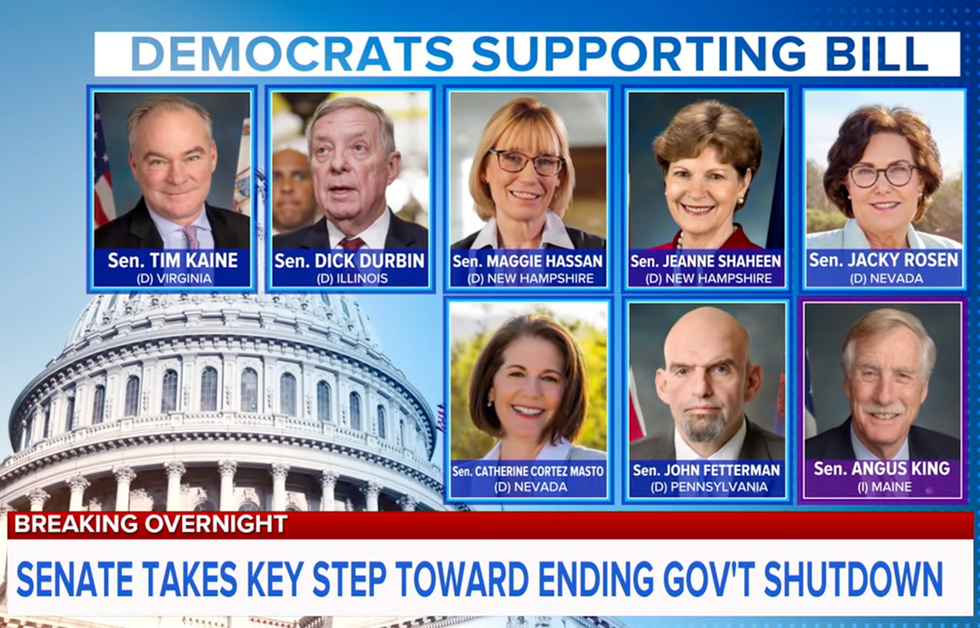
The shutdown is winding down as eight Senate Democrats (7 Democrats and one Independent who caucuses with Democrats) voted with Republicans to get to the 60 votes needed to reopen the government. The ensuing spending plan will not include the health coverage subsidies for which the Democrats were holding out. There is a lot of legitimate anger at the “defectors.” If you were going to cave, why wait until day 40? With public opinion leaning your way, why let up? Especially when this is the only leverage you’ve got? And how can you shake hands with these thoroughly untrustworthy Reppublicans, who have blatantly and illegally ignored previous spending allocations? All for the promise of a show vote on the health-coverage tax credits next month, a vote that will almost surely fail?! Also, some of what the moderate Democrats are claiming they “got” in the deal are not at all Republican concessions, specifically rehiring government workers illegally laid off during the shutdown and “fully funding SNAP.” Simply getting the other side to obey the law may look like a win these days, but it is not. Still, there are a number of arguments that point the other way, ones I’d argue are more compelling, though if and only if the fight we saw in the shutdown regarding who’s fighting for whom continues to rage. If these moderates don’t work with the rest of the Democratic caucus to build on the political and messaging gains made during the shutdown, then they really are part of the problem, not part of the solution. The main argument for ending the shutdown was that the Ds were not going to get the tax credits and too many people were feeling the brunt of the shutdown. The former is probably true; the latter is definitely true. The group of people affected by the shutdown grew with each week, beyond the hundreds of thousands of federal workers who have not been paid for weeks. The Trump administration’s legal fight to avoid paying SNAP food assistance benefits put tens of millions of Americans at risk of going hungry. And its decision to ratchet back air traffic capacity ensnared millions of others in air travel disruptions and flight cancellations that began over the weekend. Given that these two facts-probable loss on tax credits and spreading pain-were highly predictable from the start, why shutdown at all? For one, minority leader Schumer understood that the party was itching for a fight with what is, hands down, the worst, most spineless GOP Senate caucus of any of our lifetimes. On a daily basis, they bow before their corrupt leader and violate their vows to protect the Constitution. Granted the leverage that shutdown gave them, Senate Democrats had to pitch a fight. And they pitched a uniquely strong one. They made the Republicanss own the highly potent health-care (un)affordability issue, and they’ll get another chance to elevate that issue next month when Republicans continue to stand by while 20-plus million people see their premiums spike. My sense, backed by some polling evidence, with the most important polls being last Tuesday’s mini-blue-wave, is that a very important sentiment is clarifying among voters: the Trump administration doesn’t care a whit about their economic concerns but the Ds do. I grant you, that last bit-”the Democrats do”-is an uphill battle and is just now maybe coming into focus. The shutdown underscored that for Republicans, unaffordability and cruelty are spectator sports. This leaves Democrats as the only party in the game. No question, the party is suffering from years, if not decades, of being perceived as abandoning working-class economics, in many cases, justly so. But during the shutdown, they were clearly the party fighting for affordable health care, for SNAP, for government workers, while the Republicans were weaponizing the moment to push hard in the wrong direction on each of these issues. This is the fight that Democrats won in the shutdown, even if they lost on tax credits. But if they stop here, they’re toast, and deservedly so. I could be wrong-maybe this time is different-but in a few months, most regular folks won’t remember the shutdown. These events have historically had a very short half-life. But if they start here, if they learn from this shutdown that they can unify around the message of affordability, of competent governance that follows the rule-of-law, of elevating the hurt that this administration, backed by a do-nothing, wholly-compliant Congressional majority, is doing to large swaths of Americans on a daily basis, then the shutdown will have been worth it. Jared Bernstein is a former chair of the White House Council of Economic Advisers under President Joe Biden. He is a senior fellow at the Council on Budget and Policy Priorities. Please consider subscribing to his Substack. Reprinted with permission from Econjared.