general

Aave Token May Face Further 15% Drop Amid Bearish Indicators Post-Buyback

The post Aave Token May Face Further 15% Drop Amid Bearish Indicators Post-Buyback appeared com. COINOTAG recommends • Exchange signup 💹 Trade with pro tools Fast execution, robust charts, clean risk controls. 👉 Open account → COINOTAG recommends • Exchange signup 🚀 Smooth orders, clear control Advanced order types and market depth in one view. 👉 Create account → COINOTAG recommends • Exchange signup 📈 Clarity in volatile markets Plan entries & exits, manage positions with discipline. 👉 Sign up → COINOTAG recommends • Exchange signup ⚡ Speed, depth, reliability Execute confidently when timing matters. 👉 Open account → COINOTAG recommends • Exchange signup 🧭 A focused workflow for traders Alerts, watchlists, and a repeatable process. 👉 Get started → COINOTAG recommends • Exchange signup ✅ Data‑driven decisions Focus on process-not noise. 👉 Sign up → Aave (AAVE) prices are poised for a potential 15% decline, trading around the $200 psychological level amid bearish market pressures. The recent $50 million buyback program has provided some support, but increased seller dominance and range breakdowns indicate further downside to $170. Aave’s buyback initiative repurchased over 94 million tokens worth $22 million since May, aiming to reduce supply and boost confidence. The token rallied to $385 in August due to DeFi strength but has since faced prolonged weakness tied to Bitcoin’s slump. Current taker sell volume exceeds buys by a ratio of 0. 918, supporting a bearish outlook with next supports at $170 and $141. Discover how Aave’s token buyback program impacts price amid market volatility. AAVE faces bearish pressures despite deflationary efforts-stay informed on DeFi trends and predictions. What is the impact of Aave’s $50 million token buyback program? Aave’s $50 million token buyback program represents a strategic move to enhance token value through supply reduction, with weekly repurchases up to $1. 75 million based on protocol revenues. Launched as a pilot in May, it has already acquired 94.

general

Why Mutuum Finance (MUTM) Dominates as the Best Crypto to Invest in 2025 Over Cardano (ADA)

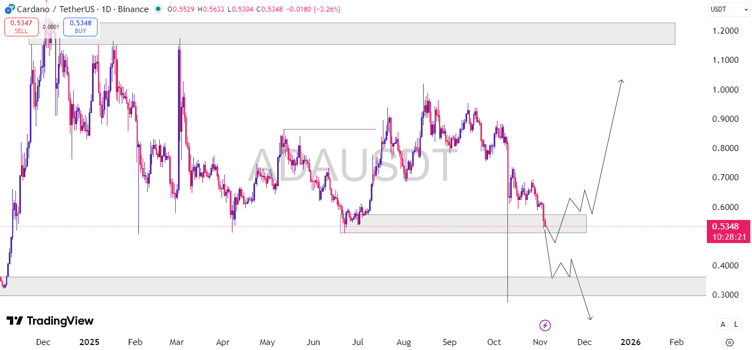
The post Why Mutuum Finance is being viewed as the best crypto to invest in for investors who are positioning early before the next market cycle. Many analysts also highlight that MUTM is emerging as the next crypto to hit $1 based on its current growth pace. And although Cardano is a legitimate project in terms of its long-term credibility, its gains at this stage will remain relatively restricted because of its large market cap and slow growth cycle, exactly why investors are shifting their funds to Mutuum Finance (MUTM) now, the low market cap DeFi crypto that’s been earlier in its growth cycle and has immense returns if market trends continue, as it’s been seen that Mutuum Finance has already broken through over $18. 5 million in its presale stage, with over 17, 800 new investors acquiring its tokens. Mutuum Finance could be the one to soon breach through the $1 market barrier in 2025, positioning itself as the next crypto to hit $1. Cardano Holding the Line Cardano (ADA) is actually currently stabilizing around the current price of $0. 5348 after a rather severe pullback, with technicals indicating that this current area is forming a solid accumulation region. In terms of market structure, it appears that Cardano is forming a definite bear trap pattern that could see it rebound from a projected pullback and proceed to a possible breakout rally that will restart its positive trends in 2026. In fact, ADA is likely to make its way back to the region of $1. 00+ if market fundamentals continue to support its current price at this one specific.

general

DeFi Turns Toward Transparency Amid Market Turmoil

The post DeFi Turns Toward Transparency Amid Market Turmoil appeared com. Balancer suffered one of the largest decentralized finance (DeFi) exploits on Monday, with more than $116 million in staked Ether and liquidity pool tokens drained from Balancer v2 contracts and several forks. The decentralized exchange (DEX) and automated market maker (AMM) investigated what appeared to be faulty access control in its smart contracts, which allowed the attackers to withdraw funds directly from liquidity pools. The exploit began with a $70 million loss, which ballooned to $116 million, primarily affecting liquid staking assets such as Lido’s wstETH and StakeWise’s osETH. In a bid to recover losses, Balancer offered a 20% white hat bounty to the attackers. The team warned that it’s working with law enforcement and blockchain forensics to identify the culprit. On Tuesday, Balancer came under scrutiny as community members pointed out the extensive audits it had undergone, only to still be hacked in the end. “Balancer went through 10+ audits,” said Suhail Kakar, a developer relations lead at the TAC blockchain. The hack also showed signs of months-long planning by a skilled attacker. Conor Grogan, director at Coinbase, said the hacker appeared to be experienced and had funds potentially linked to previous exploits. On Thursday, Balancer released a preliminary post-mortem report after the $116 million hack. The protocol said it was hit by a sophisticated code exploit that targeted its v2 Stable Pools and Composable Stable v5 pools. The event triggered stablecoin depeggings and liquidity freezes across the ecosystem due to associated assets. DeFi analysts said the protocol’s collapse had a ripple effect throughout DeFi, with millions.

general

Understand this hidden force behind every market move

The post Understand this hidden force behind every market move appeared com. Disclosure: The views and opinions expressed here belong solely to the author and do not represent the views and opinions of crypto. news’ editorial. Disclosure: This article does not represent investment advice. The content and materials featured on this page are for educational purposes only. Most retail traders look at charts and indicators like price, volume, RSI, and maybe MACD. But what really drives these numbers is something far less visible, an order flow. Order flow is the stream of buy and sell orders hitting the market every second. It’s the heartbeat of liquidity that tells you who’s buying, who’s selling, and how aggressively. Summary Order flow is the market’s hidden engine. It tracks real-time buy and sell activity, showing who’s trading, how aggressively, and where liquidity is moving, giving professionals an edge long before charts reflect it. In TradFi, order flow data fuels billion-dollar deals and opaque “two-tier” markets, while in crypto, MEV and sandwich attacks reveal a new, on-chain version of toxic flow. Advanced models now analyze flow, detect manipulation, and rebalance liquidity in milliseconds-transforming order flow from a source of hidden cost into a potential yield opportunity for traders. Professionals from Wall Street to decentralized exchanges use it to price risk, spot imbalances, and anticipate short-term moves before they show up on a chart. Understanding order flow will help you stop fighting the market’s invisible current. Why order flow matters Every market price is a negotiation between buyers and sellers. Order flow tells you how intense that negotiation is. Market makers use it to decide how wide or tight to keep their spreads. If they detect a wave of toxic flow, orders that “know something,” they widen their spread to protect themselves. Institutions rely on flow data to measure sentiment and manage inventory. A sudden influx of aggressive.

general

U.S. Treasury Secretary Lauds Bitcoin’s Resilience 17 Years Later

The post U. S. Treasury Secretary Lauds Bitcoin’s Resilience 17 Years Later appeared com. Key Points: U. S. Treasury Secretary comments on Bitcoin’s resilience despite market shifts. Bitcoin’s network is more robust than ever, Bessent notes. Potentially influences U. S. digital asset regulatory landscape. Scott Bessent, U. S. Treasury Secretary, highlighted Bitcoin’s resilience on Twitter, 17 years post its white paper release, noting enduring network robustness amidst evolving fiscal challenges. Bessent’s remarks underline Bitcoin’s secure position in the digital economy, influencing regulatory approaches and market dynamics, sustaining optimism among advocates and investors. U. S. Treasury’s Strategic Vision for Bitcoin U. S. Treasury Secretary Bessent commended Bitcoin’s durability in a tweet reflecting on the 17th anniversary of its white paper. The tweet drew attention to Bitcoin’s continued operational strength and its increasing robustness. Bessent’s pro-crypto stance aligns with a broader national strategy on digital assets. The comments underline the United States’ evolving regulatory approach as Bessent manages the strategy for a national digital assets reserve. His statements also highlight the commitment to holding seized Bitcoin assets, which could shape future fiscal policies. Market reaction was positive, evidenced by Bitcoin’s resilience despite fluctuations. Key figures, such as Brad Garlinghouse of Ripple, expressed optimism about Bessent’s influence on U. S. digital asset policy, reflecting a generally bullish outlook within the crypto community. Bessent’s commentary could guide other countries’ policies as they observe U. S. actions on digital currencies. Bitcoin’s Market Standing and Regulatory Influence Did you know? Bitcoin has maintained nearly 60% market dominance amid changing regulatory landscapes worldwide, reinforcing its pivotal role in discussions on decentralized finance. Bitcoin (BTC) currently trades at $109,877. 51, with a market cap of 2, 191, 260, 721, 900. The cryptocurrency dominates 59. 35% of the market, while trading volume is reported at $55,796,542,936. Despite recent fluctuations, including a 0. 24% price increase over the past.

economyfinancepoliticstechnology

Standard Chartered Sees Ethereum-Driven Tokenized RWAs Growing To $2T By 2028

TLDR Standard Chartered predicts tokenized RWAs could grow to $2 trillion by 2028. Ethereum is expected to dominate the tokenized RWA market, led by stablecoins. Changpeng Zhao’s lawyer demands Sen. Warren retract claims made post-pardon. Ether. fi proposes a $50 million buyback plan to stabilize ETHFI token prices. Standard Chartered’s head of digital assets research has [.] The post Standard Chartered Sees Ethereum-Driven Tokenized RWAs Growing To $2T By 2028 appeared first on CoinCentral.

businesscryptocurrencyfinanceinvestmenttechnology

Fitell Invests $1.5M in 216M PUMP Tokens to Strengthen Solana Stake

TLDR Fitell invested $1. 5 million in 216. 8 million PUMP tokens to strengthen its Solana strategy. The purchase was executed swiftly just one month after securing a $100 million Solana financing facility. PUMP tokens are central to the Pump. fun platform, a major player in Solanas memecoin ecosystem. Fitell aims to become one of the largest publicly [.] The post Fitell Invests $1. 5M in 216M PUMP Tokens to Strengthen Solana Stake appeared first on Blockonomi.

Sitemap Index