Artificial intelligence chipmaker Cerebras Systems Inc. has not given up on its ambitions to go public and could be preparing to file the paperwork for its U.S. initial public offering (IPO) as early as this week, according to a report by Reuters late Friday.
The chipmaker, which develops high-performance silicon for AI training and inference, is said to be targeting the second quarter of 2026 for its public debut. Cerebras had originally planned to enter the stock market last year, having filed for an IPO in September 2024. However, it later postponed its listing before ultimately abandoning it in October, just days after closing on a $1.1 billion funding round that valued the company at more than $8 billion.
The company first delayed and then canceled its IPO plans following reports that one of its major investors, the United Arab Emirates-based conglomerate G42, was being investigated as part of a U.S. national security review. G42 is both an investor and a customer of Cerebras and faced scrutiny by U.S. authorities over concerns that Middle Eastern companies might provide China with backdoor access to American AI and chip technologies.
However, G42 has since obtained clearance from the Committee on Foreign Investment in the United States (CFIUS), and it is no longer listed as one of Cerebras’ investors, Reuters reported. These developments have seemingly paved the way for the chipmaker to rekindle its IPO ambitions. Anonymous sources at the company told Reuters they are eager to proceed as soon as possible.
Based in Sunnyvale, California, Cerebras Systems is viewed as one of the most prominent rivals to Nvidia Corp. in the AI chip industry. The company is known for its unusual, dinner-plate-sized silicon chips, which are said to be much more powerful than the graphics processing units (GPUs) made by its rival.
Cerebras’ flagship chip, the WSE-3 processor, debuted in March 2024. Built on a five-nanometer process, the chip features 1.4 trillion transistors and has over 900,000 compute cores—more than 50 times the number found on a single Nvidia H100 GPU. It also packs 44 gigabytes of onboard static random-access memory (SRAM), which helps solve one of the major bottlenecks associated with Nvidia’s chips: bandwidth limitations.
In May, the company updated its cloud-based AI inference service, designed to run trained AI models in production, claiming it is the fastest offering of its kind in the world. Cerebras stated that its service can run the most powerful large language models at speeds exceeding 2,000 tokens per second, significantly faster than Nvidia GPU-based inference services.
Investors have shown enormous appetite for AI startups over the last couple of years, and demand has remained strong even amid economic volatility caused by U.S. President Donald Trump’s sweeping tariffs earlier this year. However, Cerebras’ window of opportunity might be closing fast as talk of a “bubble” in the AI market continues.
So far, IPO activity has held up well, with new listings raising a combined $46.15 billion this year—excluding blank-check firms—according to data from Dealogic. That represents a 21% increase compared to the previous year.
Cerebras isn’t the only big name looking to take advantage of potential market interest. Earlier this month, reports emerged that Elon Musk’s spacefaring company, SpaceX Corp., is also eyeing an IPO next year.
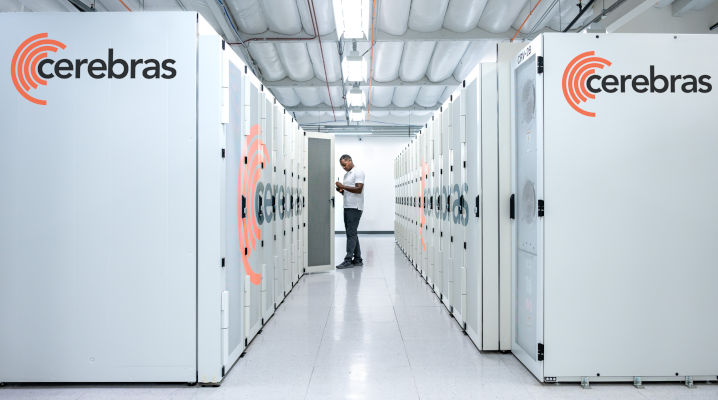
*Photo: Cerebras Systems*
https://siliconangle.com/2025/12/21/report-ai-chipmaker-cerebras-systems-rekindles-ipo-plans-targeting-early-2026-listing/