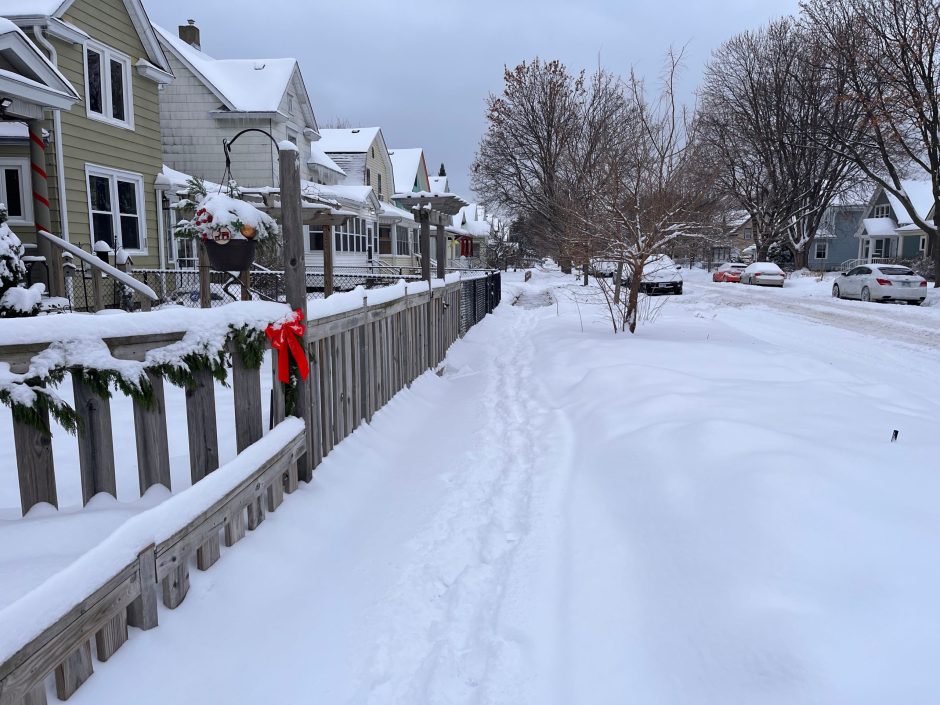
My New Year’s resolutions typically involve some kind of personal growth. In recent years, for example, walking more to deeply connect with my city and environment. Not this year. Maybe it’s the national political mood, but in 2026 I’m going down a path toward retribution. My resolution is to spend much more time reporting sidewalk shoveling scofflaws.
—
In the past, walking to my light-rail stop or other wintertime destinations, I often vowed to report every unshoveled sidewalk I happened across — typically one per block in my part of Frogtown. In truth, I rarely took the actual time to use my phone or computer and send proper time-stamped photographs. Most scofflaw consequences remain in my head, part of a long and ongoing personal tally of neighborhood karma.
I imagine there are hundreds of people like me out there, quietly casting a slippery side eye through their winter walks. This year, let’s start turning passive-aggression into active civic involvement: report the schmucks.
—
### How to Make a Report
Both core cities have processes for reporting uncleared sidewalks.
For years, Minneapolis has relied on its relatively seamless reporting tool, the “311 app.” Download it to your phone, set up an account, and you can report sidewalk offenders and you’re good to go. From there, it’s a matter of navigating a few decision trees and filling in some tables.
Until recently, St. Paul had been a lot less efficient. I was told by one City Hall insider that it was easy: simply send an email to the Department of Safety and Inspection with some details, and the staff would be “keeping eyes on it.” That’s not really a system that scales well.
This year, St. Paul rolled out a new public-facing database called PAULIE, which has improved the usability and efficiency of the city’s property data. (Whenever I hear about it, I think of this guy from *The Sopranos.*) Reporting through the new system is theoretically simpler once you get an account with the city. That said, for me, the location engine was quite glitchy. I found myself reporting an address in Saint-Paul on Reunion Island in the Indian Ocean; clicking on a citywide map would be preferable.
—
### Related:
[Using fencing on sidewalks to curb homelessness in the Twin Cities is an insult](#)
—
Since sidewalks are fundamental to urban mobility, I suggest Minneapolis and St. Paul streamline snow removal reporting by prioritizing it on a public-facing interface. If cities want hundreds of reports (and they should), make it simple: open the app, press one or two buttons, take a photo, and that’s it.
Ideally, the reports would be geo-tagged, and users should not have to fill in the same data repeatedly, such as inputting “sidewalk violation” over and over again.
This is important because the stakes for these kinds of violations are higher than other types of nuisance ordinances like noise or unmowed grass.
> “Simplify the form,” said Minneapolis’ Ellen Mueller of the 311 app. “The user experience is eye-rollingly terrible.”
—
### A Complaint Is Just the First Step
It turns out that lodging the complaint is the easy part, and this step begins the saga of unshoveled sidewalks. Each city has a laborious process after a report is filed, and I’ve written before about the challenges involved here.
Once someone files a complaint, it typically takes two or three business days for actual change to happen on the ground. By then, of course, the slippery ship has sailed, or it’s snowed again which, as Minneapolis resident Andrew Escobedo told me, “resets the clock.”
> “It really needs to move faster,” said Martin McNulty, who lives in Minneapolis’ Windom Park. “The current process involves sending out an inspector to issue a notice to property owners to clear the sidewalks within three days or so. And then only after that time does a crew come out to clear it. That’s a week-long process.”
In Minneapolis, after the end of the snowfall and the required four- to 24-hour period elapses (commercial and residential, respectively), a first-violation courtesy letter is sent out. For repeat offenders, the city skips right to inspection. Even if the inspector finds a violation, sidewalk clearing is the responsibility of a contractor who then takes up to 72 hours to do the literal grunt work.
If the city could only give the inspectors a shovel, the situation would be vastly improved.
As usual, St. Paul’s process is pretty much the same, only lengthier and less specific around timelines. (For example, the city always sends a “printed notice,” even to repeat offenders.)
For both cities, reviews of civic performance varied among the dozen residents I reached out to. For Minneapolis, the highest response grade ranged from an A- (from Whittier neighborhood’s Bennett Hartz) to a D+/C- from one resident in the Field neighborhood.
The biggest improvement cities could invest in to affect results on the ground (not a metaphor) would be to cut out the middle step and speed up the results.
Obviously, there needs to be some due process—otherwise the system could be turned into a tool for harassment, as has happened with elected officials in the past. But with the requirement for photographs, there’s no reason why an extra letter needs to be sent out to inform repeat offenders. The well-known ordinances have been in place for decades.
—
### Patterns and Repeat Sidewalk Offenders
According to my small cast of experts, smaller apartment buildings and auto-oriented businesses are the biggest repeat offenders. I’d love it if cities could start treating these problem properties proactively rather than waiting.
> “It’s often the same properties every time,” said Stephen Heuer, who lives in Minneapolis’ East Isles area. “Rental properties like duplexes and triplexes, and car-oriented businesses such as auto parts stores, gas stations, and truck rental places—specifically U-Haul—tend to be the worst offenders in my experience.”
My advice would be to make the violation list public and publicly shame repeat offenders much like how anyone can look up speed camera violations in New York City for any license plate.
Minneapolis has the outline of such a system in place through its ambitious Snow and Ice Dashboard, offering the prospect of searching individual addresses and even being able to request before-and-after sidewalk photos. That said, every time I have tried to use it, with multiple browsers, it has not worked at all.
—
### Municipal Show Shoveling: A Challenging Proposition
This discussion raises the question of municipal show shoveling, a cause célèbre for some mobility activists. Though I appreciate the advocacy effort, I’m still personally skeptical that such a system would work well in our cities.
St. Paul only recently initiated municipal garbage pickup, it relies on alley captains to arrange plowing, and it’s still waiting for curbside composting. The logistical and staffing complexity for municipal sidewalk clearing would require fine-tuned detail. It’s not something I see as possible outside of science fiction, given current political challenges and budget limitations.
Yet the current system, such as it is, could certainly be improved. I’d love to see incoming city leaders take the reins by focusing on problem properties, streamlining reporting, and speeding up the fine and clearance timeline.
> “More transparency would help,” Heuer said. “Most reports are closed with a note that an inspector sent a letter, but it’s unclear whether there’s follow-up if the sidewalk still isn’t cleared. Knowing whether there’s a recheck or escalation would build more confidence in the system.”
Of course, we could start with government-owned properties, about which there is a lot to be said. (See also: bus stops, MPRB property.)
I’m also cautiously curious about the kinds of pilot programs in place in Minneapolis for commercial districts and transit routes where sidewalk scofflaws can be cleared by municipal crews.
—
### Extreme Measures and Community Action
More extreme measures are also on the table.
The most avid sidewalk scofflaw reporter I could find, Loring Park’s Taylor Dahlin, reported that she not only uses the 311 app but also leaves comments with repeat offenders.
> “It’s effective to call them!” Dahlin told me. “It shows businesses and apartments that people in the community notice, and they can’t dismiss the issue as easily when it’s people bugging you—not just the city. It usually works a lot better than just doing 311 reports.”
At any rate, I’ll be doing my part in 2026, becoming a dogged taker of photos and user of apps. If twice or three times as many people reported scofflaw property owners, I think we could move the needle on raising the priority of sidewalk clearance in the Twin Cities.
https://www.minnpost.com/cityscape/2026/01/report-sidewalk-scofflaws-lets-get-serious-about-those-who-dont-shovel/