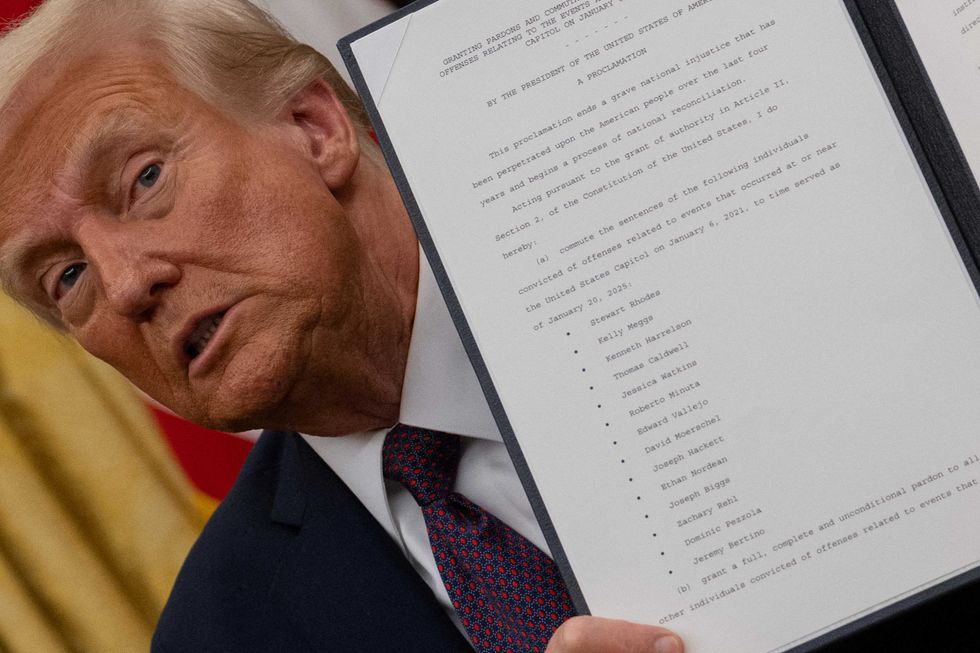
The beneficiaries of President Donald Trump’s mercy in his second term have mostly been people with access to the president or his inner circle. Those who have followed the rules set out by the Department of Justice, meanwhile, are still waiting. Trump has granted clemency to allies, donors and culture-war figures as well as felons who, like him, were convicted of financial wrongdoing. On Friday, he granted pardons to 77 people, including Rudy Giuliani and other allies tied to efforts to overturn the 2020 election, though they are mostly symbolic because federal pardons do not apply to ongoing or possible state prosecutions, which many of the grantees face. Those clemencies came on top of the commutation awarded last month to George Santos, the disgraced former New York congressman found guilty of defrauding donors and lying to the House of Representatives. Trump cut short Santos’ seven-year sentence after less than three months. For those who followed the standard protocol set out by the Department of Justice, the sense is growing that the process no longer matters; they’ve watched the public database of applicants swell with thousands of pending cases, while Trump grants pardons to people who never entered the system at all. In just over nine months back in office, roughly 10, 000 people have filed petitions for pardons or commutations, about two-thirds the total of the 14, 867 applications submitted during the entire Biden presidency. Under Justice Department standards and requirements, people seeking pardons generally must wait five years after their release from incarceration, demonstrate good conduct and remorse, and file petitions through the Office of the Pardon Attorney. But Trump’s actions in his second term show he has largely abandoned that process. Those who have followed the rules are still waiting. They include small-business owners with decades-old fraud cases, veterans seeking to regain the gun rights that were stripped away with their convictions and people working jobs far below their experience because of the stigma of a criminal record.“It’s unfair to the little guy,” said Margaret Love, who served as pardon attorney from 1990 to 1997 under Presidents George H. W. Bush and Bill Clinton and now represents people in clemency cases. “I tell people, ‘Sorry, you don’t have a chance.’”The pattern began in Trump’s first term, when fewer than half of his clemency recipients had applied through the Office of the Pardon Attorney. By one estimate, only 1 in 10 had been recommended by career officials in that office. In his second term, the break from the formal process has only widened: Only 10 of the roughly 1, 600 people granted pardons had filed petitions to the Office of the Pardon Attorney, and even within that small group, some did not appear to meet the Justice Department’s standards and requirements. A huge chunk of the pardons, roughly 1, 500, were people convicted for their roles in the Jan. 6, 2021, riot at the Capitol. The rest have come largely through back channels. In some of the more striking cases, Trump’s pardons erased not only criminal convictions for defendants tied to large-scale corruption and financial crimes but the restitution judges had ordered or that defendants had agreed to pay. The Justice Department did not respond to questions about why many recent pardons appear to have come outside the traditional review process or why the president has tended to use his clemency power to help political allies and people convicted of financial crimes or public corruption. A spokesperson for the department said in an email that the Office of the Pardon Attorney is processing clemency applications. “The Department,” the spokesperson said, “is committed to timely and carefully reviewing all applications and making recommendations to the President that are consistent, unbiased, and uphold the rule of law.”Last month, Trump pardoned Changpeng Zhao, the billionaire founder of the cryptocurrency exchange Binance, who had served four months in prison after pleading guilty in 2023 to charges of enabling money laundering. The Wall Street Journal reported that Binance had hired a lobbyist to pursue the pardon. The company has also supported Trump’s family’s crypto ventures. In a “60 Minutes” interview, Trump said that “a lot of people asked me” to pardon Zhao and that he “didn’t know him personally.” White House Press Secretary Karoline Leavitt said last week that there was a “whole team of qualified lawyers who look at every single pardon request” and that Trump was the final decision-maker. She said he was “very clear when he came into office that he was most interested in looking at pardoning individuals who were abused and used by the Biden Department of Justice and were overprosecuted by a weaponized DOJ.” A House Judiciary Committee report written by Democratic staffers which Republicans on the panel did not respond to found that Trump’s second-term pardons had wiped out more than $1. 3 billion in restitution and fines owed to victims and to the public. The White House called the report “pointless.”Last month, the Securities and Exchange Commission, now led by Trump appointees, dropped parallel civil cases that could have forced several defendants who were granted clemency by Trump to return hundreds of millions of dollars more, leaving victims with little recourse beyond private lawsuits. But it’s not as if Trump broke a system that was working. A president’s pardon powers are considered absolute. For years, the clemency process has been criticized as slow, opaque and riddled with conflicts of interest with Department of Justice attorneys helping to decide the fate of the very people they once sought to imprison. Presidents were usually faulted for using the power too sparingly to right wrongs. Trump had a rare opportunity to fix the system. Instead, experts said, he has exploited it.“If you’re a donor or political supporter, you move to the front of the line,” said Jim Hux, a lawyer representing a Missouri man seeking a pardon for tax crimes he committed two decades ago. He said his client has “led a model life” since finishing his sentence and fits the other criteria the Justice Department says it looks for.“He’d love to take his grandson hunting and can’t do that because he can’t possess a firearm,” Hux said. He asked that his client not be named. But after months of watching Trump issue clemency to people who didn’t meet the criteria and who never went through the Office of the Pardon Attorney Hux said that he was discouraged.“If you’re just an average citizen, you can’t even get in the line,” Hux said. “I told my guy he’d probably be better off if he broke into the Capitol or made a major donation to Trump’s inauguration.”In the fall of 2018, Jared Kushner convened a meeting in the Roosevelt Room of the White House. In attendance were his wife, Ivanka Trump, conservative legal activist Leonard Leo, former Obama adviser Van Jones and Kevin Sharp, a former federal judge who had resigned from the bench in protest over mandatory sentencing laws and had become an advocate for clemency reforms. Also in the room was Kim Kardashian, the reality television star who had reinvented herself as a criminal justice advocate. She had already successfully lobbied Trump to commute the life sentence for Alice Marie Johnson, a grandmother from Tennessee who had served more than two decades for cocaine trafficking and who became a national symbol of the harsh mandatory sentences imposed on nonviolent drug offenders. (During the Republican National Convention two years later, Trump would go on to grant Johnson a full pardon.)Johnson’s release helped pave the way for the conversation. Kushner brought in legal scholars to talk about reform, inviting Mark Osler of the University of St. Thomas in Minnesota and Rachel Barkow of New York University to explain how the clemency system worked, why it failed most applicants and what it would take to fix it. Many observers of the presidential clemency system agreed it needed fixing. Strong cases languished in bureaucratic limbo while families of applicants pleaded in vain. Then, Trump had an opportunity to repair it. His feud with his own Justice Department during the investigation into election interference by Russia gave him space to rethink the process, to pull clemency away from the bureaucracy. Kushner had a strong interest in mercy and second chances. His father, Charles Kushner, had been charged with tax and campaign-finance crimes. Prosecutors said he had arranged for a prostitute to lure his brother-in-law into a videotaped encounter and sent the tape to his sister before she was due to testify against him. Kushner pleaded guilty and went to prison. Jared Kushner would later write in Time magazine that he had spent time with families of people in prison and “knew from that experience how much those people would benefit from having someone in my office who cared about this issue.”Standing at opposite ends of a conference table, the law professors proposed an independent board to review petitions quickly and fairly, free from prosecutorial bias. It would be similar to President Gerald Ford’s post-Vietnam War clemency commission, which reviewed petitions from draft resisters and evaders, recommended pardons or alternative service for them and reported directly to the president. According to Osler, a leading expert on clemency, the participants had questions after the presentation, but there was no obvious dissent. The participants, he said, seemed to agree that his and Barkow’s proposal was the best path forward. Barkow declined to comment. Sharp recalled that, after the meeting, he met again with Kushner and a few others.“Jared, in our post-meeting, seemed to agree with all of that,” Sharp said. “The question was, what would it look like? We sat back there and kind of mapped out scenarios of what one of these commissions would look like, how potential clemency applications funnel through and who would look at them before sending those recommendations to the president.”Sharp said the commission “would have people with experience from the prosecution side of the justice system, people with experience on the defense side of the system, citizens who worked in these areas and were familiar with the issues.”“And then,” Sharp said, “it just withered on the vine.”Kushner did not respond to requests for comment. Trump did advance significant criminal justice reform when he signed the First Step Act in December 2018. The bipartisan measure eased certain federal sentences by addressing disparities in drug penalties and giving judges added flexibility in sentencing nonviolent offenders. While not a pardon, some legal experts have described the law as a structural act of clemency because it reduced mandatory sentences and allowed earlier release for thousands of prisoners. Trump handed out pardons on his own terms, though. Many of his first-term pardons came after he had lost the 2020 election, including to campaign aides and four of the six associates who were convicted in the investigation by special counsel Robert Mueller into Russian interference in the 2016 election. Among the people granted pardons: Charles Kushner, whom Trump in his second term named U. S. ambassador to France and Monaco. Rather than rely on the Justice Department’s traditional review system, Trump in his second term has built a parallel network of mercy led by political allies and media figures who can reach him directly. He appointed Ed Martin, a longtime Missouri political operative and early Trump backer, as pardon attorney and the head of a new Weaponization Working Group at the Justice Department after Martin’s nomination for U. S. attorney for the District of Columbia was withdrawn when Republican senators pulled their support. Martin’s dual role was a sign that pardons had become more overt political weapons. He pledged to scrutinize Biden-era pardons and review what he described as a “weaponized” justice system. After Trump pardoned Scott Jenkins, a sheriff in Virginia and a longtime supporter convicted of taking bribes for political favors, Martin posted on X, “No MAGA left behind.”Martin did not respond to requests for comment. A recent NBC News report described pardons being overseen by a tight circle led by Chief of Staff Susie Wiles and White House Counsel David Warrington. Johnson, the drug offender whom Kardashian had convinced Trump to free, advises on drug cases as Trump’s “pardon czar.”Johnson’s position is new. She has said she helps find people serving or who have served long prison sentences for nonviolent crimes and have been rehabilitated and can safely reenter their communities. She also seeks out people she believes were targeted for political reasons and submits their names to Trump. But it’s not clear how people without connections are supposed to reach her or what standards she uses to decide which names make it to the president. Johnson has no public contact information and did not respond to messages seeking comment sent to the White House and to her personal email account and Facebook page. Warrington and Wiles, as well as the White House, also did not respond. Some lawyers said Johnson’s influence has been minimal. One clemency attorney who represents multiple clients, and who spoke on the condition of anonymity to protect the chances of his clients receiving clemency, told ProPublica that, in Trump’s second term, he does not necessarily file cases with the Office of the Pardon Attorney. The most effective route, he said, is a direct line to the Office of the White House Counsel. Osler said he doesn’t know how to reach Johnson or anyone else on Trump’s pardon team. He runs a law-school clinic where students file clemency petitions for people they believe deserve a second chance but said, “We don’t know what the process is.”“It’s not Alice’s fault, but this is not what we proposed,” he said, referring to the reform plan he and Barkow presented to Trump’s team in the president’s first term.“Clemency is not meant to be a function that operates within a closed circle,” he said. “It’s something the Constitution establishes to give hope to the many including those who don’t have the resources, the fame or the connections to navigate the current system.”Liliana Trafficante is one of the thousands hoping for clemency. that she was running for the New York City Council. But under a 2021 city law, she could not legally take office even if voters elected her unless Trump pardoned her. She registered a campaign committee but ultimately didn’t enter the race. Trump’s return to office inspired her to seek a pardon. “I mean, he was going through his own criminal court case and yet he’s the president,” she said. “I was like, ‘OK, this is my guy.’”Tony Gene Broxton, a former fire department bookkeeper from the Florida Panhandle, was indicted in 2013 on federal charges of theft of public money and making false statements. Prosecutors said he stole more than $200,000 in government benefits from the Social Security Administration and the Department of Veterans Affairs over several years while working for his local fire district. He pleaded guilty and was sentenced to five years of probation and a year of house arrest. He made restitution for the full amount, court records show. As a convicted felon, Broxton lost his right to possess a gun. He applied for a pardon during the first Trump presidency, but it was finally denied by the Biden administration in 2023. After Trump returned to office, he applied again.“I can’t go hunting with my rifles,” he said. “I can’t go target shooting with my wife. All my guns are in storage, locked up. I don’t even have access to them.”He thought it was a good sign when, on his first day back in office, Trump pardoned the roughly 1, 500 Jan. 6 defendants. He believed that Trump would have an attorney review petitions and start approving some of them. He checks the status of his case every day.“But,” he said, “every time I go online it just says, still pending.”.